
The Argonne Training Program on Extreme-Scale Computing (ATPESC) has issued its Call for Applications. The event will take place from July 26–August 7 in the Chicago area. “ATPESC provides intensive, two-week training on the key skills, approaches, and tools needed to carry out scientific computing research on the world’s most powerful supercomputers.”
Supercomputing the Mysteries of Boron Carbide
January 17, 2020 by
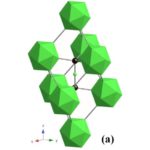
Researchers at the University of Florida are using XSEDE supercomputers to unlock the mysteries of boron carbide, one of the hardest materials on earth. The material is also very lightweight, which explains why it has been used in making vehicle armor and body protection for soldiers. The research, which primarily used the Comet supercomputer at the San Diego Supercomputer Center along with the Stampede and Stampede2 systems at the Texas Advanced Computing Center, may provide insight into better protective mechanisms for vehicle and soldier armor after further testing and development.
Coding Dojo Launches Immersive Data Science Bootcamp
November 10, 2019 by

Today education company Coding Dojo launched the Data Science Immersive bootcamp, a new program designed to teach and apply Data Science methodologies and tools so participants can solve real-world problems in business and academia. The 14-week course was developed to meet the growing employer demand for skilled Data Scientists, which rose by 31% since December 2018 and an astonishing 256% since December 2013, according to research by Indeed.com. The curriculum was designed by Isaac Faber Ph.D., the Chief Data Scientist for education and collaboration startup MatrixDS.
Video: High-Performance Computing with Python – Reducing Bottlenecks
August 11, 2019 by

This course addresses scientists with a working knowledge of NumPy who wish to explore the productivity gains made possible by Python for HPC. “We will show how Python can be used on parallel architectures and how to optimize critical parts of the kernel using various tools. The following topics will be covered: – Interactive parallel programming with IPython – Profiling and optimization – High-performance NumPy – Just-in-time compilation with Numba – Distributed-memory parallel programming with Python and MPI – Bindings to other programming languages and HPC libraries – Interfaces to GPUs.”
SC19 Posts Workshop Schedule
May 8, 2019 by

“These topical workshops are bringing together hardware and software trends spanning various subjects including data analysis, visualization, machine learning for HPC, deep learning, performance benchmarking, parallel computing, correctness, computational reproducibility along with education for HPC. This broader set of topics is just another testimony of how SC19 is reaching out and including new communities.”
Register for the Altair Student Competition for Innovation in Electromagnetics
April 29, 2019 by
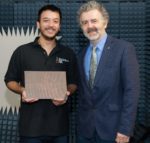
Altair invites engineering students from across the globe to participate in their Student Competition for Innovation in Electromagnetics. “At a time when energy efficiency is a global priority, students can use Altair software to design future generation e-motors and other electric equipment. Think of what a tremendous impact they can make on the planet. Altair software solutions are broadly used in the academic engineering communities and am already looking forward to the many innovative entries in both areas of electromagnetics.”
Sign up for ISC STEM Student Day
April 18, 2019 by
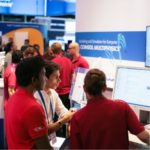
Young people looking to further their careers in HPC are encouraged to sign up for the ISC STEM Student Day program. As part of the ISC High Performance Conference coming to Frankfurt in June, this program offers undergraduate and graduate students an early insight into the field of high performance computing as well as an opportunity to meet the important players in the sector.
NERSC Hosts GPU Hackathon in Preparation for Perlmutter Supercomputer
February 25, 2019 by
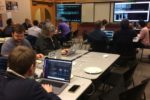
NERSC recently hosted a successful GPU Hackathon event in preparation for their next-generation Perlmutter supercomputer. Perlmutter, a pre-exascale Cray Shasta system slated to be delivered in 2020, will feature a number of new hardware and software innovations and is the first supercomputing system designed with both data analysis and simulations in mind. Unlike previous NERSC systems, Perlmutter will use a combination of nodes with only CPUs, as well as nodes featuring both CPUs and GPUs.
HudsonAlpha to host BioTech Hackathon in Huntsville
February 3, 2019 by

The HudsonAlpha Institute for Biotechnology will host the second HudsonAlpha Tech Challenge February 22-24, 2019. This life sciences hackathon brings together students and professionals who attempt to solve challenges using an emerging technology, and apply it to biotech and the life sciences. “The HudsonAlpha Tech Challenge is a great opportunity to introduce genomics, genetics and biotech to existing and emerging leaders in computer science and technology,” said Adam Hott, EdD, digital applications lead at HudsonAlpha.”
Choice Comes to HPC: A Year in Processor Development
January 27, 2019 by
In this special guest feature, Robert Roe from Scientific Computing World writes that a whole new set of processor choices could shake up high performance computing. “While Intel is undoubtedly the king of the hill when it comes to HPC processors – with more than 90 per cent of the Top500 using Intel-based technologies – the advances made by other companies, such as AMD, the re-introduction of IBM and the maturing Arm ecosystem are all factors that mean that Intel faces stiffer competition than it has for a decade.”