
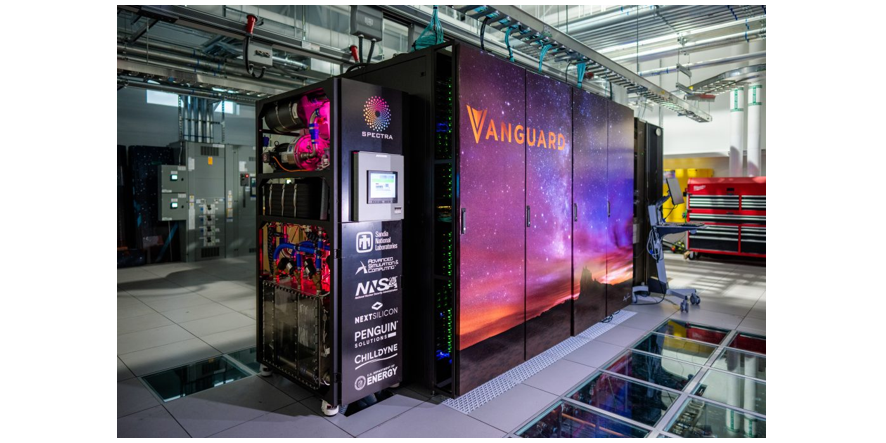
Sandia National Laboratories has announced the arrival of its newest most unconventional supercomputer.
Designed through a collaboration between Sandia and NextSilicon, the “Spectra” prototype system is designed to process data in a fundamentally different way than most computers. If successful, Spectra could reshape how the lab performs high-stakes simulations critical to its nuclear deterrence mission, Sandia said.
Spectra features 128 of NextSilicon’s Maverick-2 dual-die accelerators, specialized chips that analyze code to prioritize tasks in real time. This is a major design departure from CPUs or GPUs, which typically treat all data equally. The potential payoff is increased performance and reduced power consumption. It is the first supercomputer to incorporate this new chip architecture.
The Maverick-2 is designed to focus on the critical codes and workflows that run the majority of the time in HPC and AI environments. Its self-optimizing architecture delivers immediate, scalable performance improvements, according to NextSilicon, by creating software-defined processor cores tailored to the performance needs of each application and then executed on the accelerator hardware. As applications run, telemetry data is fed to NextSilicon’s algorithms to continuously self-optimize performance, power consumption, and utilization in real-time. The result is efficient performance at scale for the most demanding HPC applications while consuming 50-80 percent less power than traditional GPUs, the company said.
“We have deployed a first-of-its-kind computing capability,” said Sandia senior scientist and project lead James Laros. “And it’s the result of this tremendous partnership between the national labs and industry.”
Sandia researchers will now push this architecture prototype. They’re leading a consortium with Lawrence Livermore and Los Alamos national laboratories under the National Nuclear Security Administration’s (NNSA) Advanced Simulation and Computing program. Ultimately, the team wants to know how the system handles national security-related tasks such as advanced fluid dynamics simulations, which help assess the nation’s nuclear deterrent without underground testing.

If successful, the research could mark a path forward for more sophisticated simulations.
Spectra is the second platform deployed as part of Sandia’s Vanguard program, which explores the viability of emerging technologies for ASC mission applications.
“By deploying prototype systems, we investigate whether new technologies can be integrated into our large production platforms in the coming years,” said Simon Hammond, director of the Office of Advanced Simulation and Computing and Institutional Research and Development Programs at NNSA.
The first Vanguard system, Astra, was the world’s fastest Arm-based supercomputer in 2018. It was a pivotal experiment showing that Arm processors, traditionally used in embedded applications like cellphones and car electronics, could be successfully adapted for heavyweight jobs such as modeling and simulation.
“While it seems obvious today that Arm-based processors can handle demanding workloads, at the time of Astra’s deployment the software stacks, compilers and libraries were untested and lacked necessary optimizations for production environments,” Hammond said.
Astra’s success led other labs to follow. Los Alamos deployed Venado, a full-size, partially Arm-based supercomputer, in 2024. Now Sandia and NextSilicon aim to achieve a milestone with Spectra, focusing on efficiency and adaptive computing.
“Breakthrough scientific discoveries require breakthrough computing architectures,” said NextSilicon CEO Elad Raz. “We built Maverick-2 because when researchers wait hours for simulations that could unlock major breakthroughs, the bottleneck isn’t human imagination — it’s computing efficiency.”
An advantage of the Maverick-2’s experimental design is that it simplifies porting applications to the new system. Raz said, “We deliver up to 10x performance improvements at half the power without requiring users to rewrite their applications.”
This could save months to years of work optimizing software to the latest hardware, making NNSA programs more agile and saving taxpayer dollars.
 While Sandia will evaluate the extent of this backward compatibility, Laros confirmed that on day one the system could support the supercomputing benchmark test HPCG, the molecular dynamics simulation LAMMPS and the Monte Carlo code SPARTA, which Sandia researchers regularly use to simulate low-density gases.
Spectra was integrated and installed by Penguin Solutions with scalability in mind. The company designed an innovative server that can support up to four high-performance NextSilicon Open Accelerator Modules running at full power, although the current setup uses two.
“We engineered a system with aggressive capabilities so that Sandia could fully explore the entire envelope of power and performance of the chips over time,” said Phil Pokorny, chief technology officer at Penguin Solutions. “Sandia will have plenty of room to grow this cluster to higher levels of performance.”
An advanced Chilldyne negative pressure liquid cooling system and Penguin’s Tundra infrastructure for thermal management, power distribution and scaling, enable the flexibility. Penguin adapted these solutions to the power infrastructure of Sandia’s data center.
“Revolutionary new designs are among the most fascinating to learn about and work on,” Pokorny said. “Being part of delivering such a new design is a rare opportunity. It’s very exciting!”
For Sandia and NNSA, Spectra is a testbed for a future where computing advances come not from bigger machines, but from smarter, more adaptive designs.