
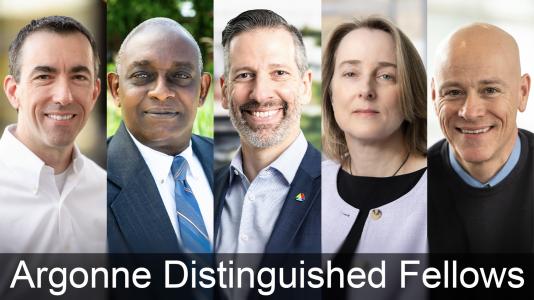
From left: Robert B. Ross, Temitope A. Taiwo, Seth B. Darling, Katrin Heitmann and Kenneth M. Kemner. (Image by Argonne National Lab)
Argonne National Laboratory named five scientists as Argonne Distinguished Fellows in 2025. They are Seth B. Darling, Katrin Heitmann, Ken Kemner, Robert Ross and Temitope Taiwo.
This honor is awarded to scientists who have earned international recognition and demonstrated exceptional accomplishments in science or engineering that directly support Argonne’s core missions. Argonne Distinguished Fellows are at the helm of major, complex and high-priority initiatives that shape the laboratory’s future. Fewer than 3 percent of Argonne’s research staff receive this elite recognition.
The awardees are:
Katrin Heitmann is a physicist and computational scientist whose research in precision cosmology uses high performance computing to explore the universe’s large-scale structure and the nature of dark energy.
She joined Argonne in 2011 and now serves as deputy director of the High Energy Physics division and leads the Cosmological Physics and Advanced Computing group. Heitmann is a senior associate for the Kavli Institute for Cosmological Physics at the University of Chicago and a member of the Northwestern-Argonne Institute of Science and Engineering.
Among her breakthroughs, Heitmann co-developed the Hardware/Hybrid Accelerated Cosmology Code, a leading platform for high-performance cosmological modeling. She also spearheaded the development of CosmoTools for simulation data analysis.
In 2007, Heitmann and her collaborators introduced the Cosmic Calibration Framework, a structured approach to providing precision predictions based on a small number of cosmological simulations to improve overall understanding of the universe. The framework has become a cornerstone of modern computational cosmology.
As a spokesperson for the Legacy Survey of Space and Time Dark Energy Science Collaboration from 2021 to 2023, Heitmann led a global team of more than 1,000 scientists to prepare for the influx of data from the Vera C. Rubin Observatory to advance dark energy research.
Before joining Argonne, she was a staff scientist at DOE’s Los Alamos National Laboratory.
A fellow of the American Physical Society, Heitmann has authored more than 100 peer-reviewed publications and is first author on 15 journal articles.
She received the 2017 University of Chicago Award for Distinguished Performance and was a finalist for the Gordon Bell Award, an award to recognize outstanding achievement in high performance computing, in 2012, 2013 and 2025.
Robert Ross is an expert in high performance computing whose innovations have transformed data and storage systems for large-scale scientific simulations.
Ross joined Argonne in 2000 as an Enrico Fermi Named Fellowship Scholar and quickly gained recognition in HPC for pioneering system software innovations that support leadership-class computing. As senior computer scientist and deputy division director in Argonne’s Mathematics and Computer Science division, he has driven foundational advances in distributed storage, parallel input/output and systems software. This infrastructure is critical for data-intensive science and large-scale simulations on DOE supercomputers.
He now directs the DOE RAPIDS Institute for AI, Computer Science, and Data, part of the DOE Scientific Discovery through Advanced Computing program. RAPIDS is spearheading national efforts to develop cutting-edge software tools that accelerate scientific discovery across DOE platforms.
Among his honors, Ross received the DOE’s Presidential Early Career Award for Scientists and Engineers in 2004. His leadership has guided Argonne teams to earn R&D 100 Awards in 2005, 2018 and 2021. In 2021, he was awarded the prestigious E. O. Lawrence Award for advances in high performance computing that serve the DOE mission.
Seth B. Darling is a materials scientist combining advanced research with real-world innovation to solve global energy and water challenges.
Darling, who joined Argonne in 2002, is chief science and technology officer for the Advanced Energy Technologies directorate. He also serves as a senior scientist in the Chemical Sciences and Engineering division and director of the Advanced Materials for Energy-Water Systems Energy Frontier Research Center, where he leads efforts to explore how water interacts with materials, enabling new technologies to improve water treatment, energy efficiency and resource recovery.
Darling’s current research centers on novel materials for removing pollutants from water and extracting valuable materials — like nutrients, metals or clean water — for reuse. Among his innovations, he developed clay-based membranes for precise separations, coatings that resist fouling to extend membrane life, and photothermal materials that harness sunlight to recover valuable resources from wastewater. He also designed molecular probes that selectively detect or remove specific contaminants, advancing targeted sensing and cleanup technologies.
He co-invented sequential infiltration synthesis (SIS), an innovative technique derived from atomic layer deposition that diffuses vapor into polymers to create functional materials such as advanced membranes, optical films and sensors. This breakthrough earned an R&D 100 Award in 2014. Using SIS, Darling co-developed the Oleo Sponge — a reusable material that efficiently removes oil from water. His work was recognized with a second R&D 100 Award in 2017.
A fellow of the American Vacuum Society, Darling has authored over 150 publications and holds more than 20 patents. His work appears in journals including Science, Advanced Materials, Energy & Environmental Science and Materials Today. He is also the author of widely read books on water and science communication. In addition to his Argonne appointments, he holds a fellowship in the University of Chicago Pritzker School of Molecular Engineering.
Ken Kemner is a physicist whose contributions are shaping the future of synchrotron science and environmental research.
He is the founder and leader of Argonne’s Molecular Environmental Science and Biogeochemical Processes group, a multidisciplinary team that combines synchrotron radiation with laboratory-based environmental chemistry and biology to investigate biogeochemical processes. Kemner is a senior scientist and group leader in Argonne’s Biosciences division, where he has served since 1996.
Kemner is globally recognized for pioneering high-energy X-ray and synchrotron techniques to reveal molecular-scale bio-environmental processes.
His research has catalyzed three major advances: imaging microorganisms and their biomineralization products to resolve key biogeochemical mechanisms; transforming the understanding of uranium behavior in groundwater systems; and elucidating mineral–metal–plant–microbe interactions across terrestrial, aquatic and subsurface environments.
These innovations are transforming biogeochemistry and advancing understanding of microbial roles in global elemental cycles.
He founded the Synchrotron Environmental Science Conference Series, a biannual event hosted at North American synchrotron facilities to promote the integration of synchrotron-based techniques into environmental science.
Kemner has authored more than 200 publications. Along with many publications in Science and Nature, his research regularly appears in other leading journals such as Environmental Science & Technology and PLOS Biology.
Temitope Taiwo is a nuclear reactor engineer whose contributions in reactor physics, fuel cycles and nuclear energy systems have shaped the field since joining Argonne in 1990.
Among his contributions, Taiwo developed computational tools and methods and performed analysis of nuclear energy systems.
One of Taiwo’s achievements — the development of the DIF3D-K spatial kinetics code — was the first to enable realistic 3D time-dependent reactor simulations. He contributed to developing techniques to model how neutrons and core state variables interact, which were used in major DOE projects like the New Production Reactor analysis. Before joining Argonne, Taiwo developed reactor models and reload cycles at Northeast Utilities. Between 1995 and 1996, Taiwo assessed international nuclear security and nonproliferation issues for the U.S. government.
Taiwo’s leadership roles include technical positions at Argonne and serving as national technical director for DOE’s Systems Analysis and Integration Campaign and as co-director of the Fuel Cycle Options Campaign. He led national efforts to evaluate and integrate nuclear energy systems, guiding sustainable fuel cycle strategies and coordinating research across U.S. laboratories. He is now Division Director of Nuclear Science and Engineering at Argonne.
Taiwo served for many years as the U.S. representative to the Organisation for Economic Co-operation and Development’s Nuclear Energy Agency’s Working Party on Scientific Issues of Reactor Systems.
He has co-authored more than 400 publications — including technical reports for DOE projects, peer-reviewed journal articles, conference papers and book chapters.
Taiwo is a fellow of the American Nuclear Society and serves on its board of directors and committees.
“Our Distinguished Fellows represent the very best of Argonne. Their achievements reflect not only extraordinary scientific talent, but also a deep commitment to advancing discovery in service to our nation,” said Argonne Director Paul Kearns. “At a time when scientific leadership, rapid innovation, and meaningful impact are more important than ever, these Fellows exemplify that spirit. They have shaped fields, strengthened our capabilities, and inspired colleagues across the laboratory. I am proud to recognize contributions that will continue to make a lasting impact on science and society.”