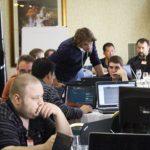
ORNL is hosting a series of GPU Hackathons in 2018. The first event will take place March 5-9 at TU Dresden in Germany. “The goal of each Hackathon is for current or prospective user groups of large hybrid CPU-GPU systems to send teams of at least 3 developers along with either (1) a (potentially) scalable application that could benefit from GPU accelerators, or (2) an application running on accelerators that need optimization. There will be intensive mentoring during this 5-day hands-on workshop, with the goal that the teams leave with applications running on GPUs, or at least with a clear roadmap of how to get there. Our mentors come from national laboratories, universities, and vendors, and besides having extensive experience in programming GPUs, many of them develop the GPU-capable compilers and help define standards such as OpenACC and OpenMP.”
Archives for 2017
Advanced Protein Prediction Using Deep Learning on Blue Waters Supercomputer
Researchers at NCSA used the Blue Waters Supercomputer and Deep Learning to achieve a breakthrough in protein structure predictions. As published in the Cell Systems journal, the research was conducted by Jian Peng, NCSA Faculty Fellow and Assistant Professor in the Department of Computer Science at Illinois and Yang Liu, a graduate student in the Department of Electrical and Computer Engineering. “Peng’s research proposes to largely explore a more accurate function for evaluating predicted protein structures through his development of the deep learning tool, DeepContact. DeepContact automatically leverages local information and multiple features to discover patterns in contact map space and embeds this knowledge within the neural network. Furthermore, in subsequent prediction of new proteins, DeepContact uses what it has learned about structure and contact map space to impute missing contacts and remove spurious predictions, leading to significantly more accurate inference of residue-residue contacts.”
Intel Parallel Studio 2018: Modernize Your Code

“Intel Parallel Studio 2018 has been designed to recognize the latest CPU architectures including the Intel Xeon Scalable processor family and the Intel Xeon Phi processors in order to get maximum performance from their differing architectures, yet remain binary compatible. With the recent introduction of the Intel AVX-512 vectorization instructions, application developers can more easily take advantage of these new instructions when developing and compiling with the Intel Parallel Studio 2018.”
4 Emerging Trends Will Transform the Field of Artificial Intelligence in 2018

In this contributed article, Robin Martinus van Ittersum of The Netherlands based AI Company, takes out his crystal ball to look into 2018 and how artificial intelligence will serve to shape the enterprise environment. Nowadays we see that technology alone is rarely enough to unlock sustainable business growth. When a new technology is combined with a ‘new ways of doing business’, true value is created. This article identifies a number of emerging trends in artificial intelligence for the coming year.
Swiss HPC Conference Returns to Lugano in April with Winter HPCXXL User Group

Today the HPC Advisory Council announced that registration is now open for the Swiss HPC Conference. The event takes place April 9-12 in Lugano, Switzerland. For the first time, the conference will be held in concert with the Winter HPCXXL User Group meeting. “We are very excited to organize a joint conference here in Lugano, bringing together the communities of HPCAC and HPCXXL,” said Hussein Harake, HPC system manager, CSCS. “We believe that such a collaboration will offer a unique opportunity for HPC professionals to discuss and share their knowledge and experiences.”
Video: Deep Learning for the Enterprise with POWER9

Sumit Gupta from IBM gave this talk at H2O World. “From chat bots, to recommendation engines, to Google Voice and Apple Siri, AI has begun to permeate our lives. We will demystify what AI is, present the difference between machine learning and deep learning, why the huge interest now, show some fun use cases and demos, and then discuss use cases of how deep learning based AI methods can be used to garner insights from data for enterprises. We will also talk about what IBM is doing to make deep learning and machine learning more accessible and useful to a broader set of data scientists, and how to build out the right hardware infrastructure.”
TriNetX Unveils Natural Language Processing to Improve Protocol Design and Accelerate Identification of Patients for Clinical Trials

TriNetX, the global health research network for healthcare organizations, biopharmaceutical companies, and Contract Research Organizations (CROs), announced the general availability of its Natural Language Processing (NLP) service.
Bringing DevOps agility to the edge with APIs

In this special guest feature, Philipp Schöne, Product Manager, Platform as a Service and IoT at Axway, discusses the critical role DevOps play in enabling IoT for modern enterprises.
Interview: Shalini Agarwal, Director, Engineering and Product at LinkedIn

I recently caught up with Shalini Agarwal, Director, Engineering and Product at LinkedIn, to discuss how we need more data scientists to make our applications smarter; however we can make them more efficient and accomplish more with data scientists by having automated workflows and tools. These tools can be used by non-data scientists to leverage the established workflows and remove the repetitive tasks from the mountain of tasks expected from a data-scientist.
Stanford HPC Conference Returns to Palo Alto in February
Today HPC Advisory Council announced its 2018 Stanford HPC Conference will take place February 20-21, 2018 at Stanford University. The annual California-based conference draws world-class experts from all over the world for two days of thought leadership talks and immersive tutorials focusing on emerging trends with extensive coverage of AI, Data Sciences, HPC, Machine Learning and more. “The Stanford Conference is an intimate gathering of the global HPC community who come together to collaborate and innovate the way to the future,” said Steve Jones, Director of Stanford’s High Performance Computing Center. “SMEs, mentors, students, peers and professionals, representing a diverse range of disciplines, interests and industry, are drawn to the conference to learn from each other and leave collectively inspired to contribute to making the world a better place.”