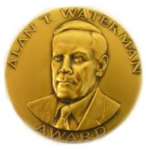
July 17, 2023 — The Alan T. Waterman is the U.S. National Science Foundation’s (NSF) Highest Honor. The award recognizes an outstanding early career researcher in any field of science or engineering supported by the NSF. In addition to a medal, the awardee receives a grant of $1,000,000 to use over a five-year period for […]
Archives for July 2023
September HPC User Forum: AI in HPC, Sustainability and Cloud Computing
July 17, 2023 by

ST PAUL, Minn., July 17, 2023 — The HPC User Forum has published an updated agenda spotlighting featured speakers for its upcoming meeting, Wednesday and Thursday, Sept. 6-7, 2023, in Tucson, Arizona at the Loews Ventana Canyon Resort. The full agenda and registration information can be found here. There will be sessions and panel discussions focused […]
GigaIO Introduces 32 GPU Single-Node Supercomputer
July 17, 2023 by
Carlsbad, California, July 13, 2023 – GigaIO, provider of workload-defined infrastructure for AI and technical computing, recently announced that it successfully configured 32 AMD Instinct MI210 accelerators to a single-node server utilizing the company’s FabreX PCIe memory fabric. Available today, the 32-GPU engineered solution, called SuperNODE, is designed to offer a simplified system capable of […]
HPC News Bytes: SC23, China Tech Export Controls, Linux Wars Expand, Chiplet Scale-out, Quantum
July 17, 2023 by

Happy Monday! Here’s this week’s HPC News Bytes podcast for 20230717, a quick compendium of the most important news in HPC, AI, quantum and other advanced technologies. This week, Shahin and Doug discuss: SC23 registration opens; China technology export controls and Intel shipping lesser SKUs; Linux-Red Hat wars expand; Chiplet scale-out, or is it cloud?; Quantinuum tackles the hydrogen molecule (H2), it’s a start….
Brief History of LLMs
July 17, 2023 by

The early days of natural language processing saw researchers experiment with many different approaches, including conceptual ontologies and rule-based systems. While some of these methods proved narrowly useful, none yielded robust results. That changed in the 2010s when NLP research intersected with the then-bustling field of neural networks. The collision laid the ground for the first large language models. This post, adapted and excerpted from one on Snorkel.ai entitled “Large language models: their history, capabilities, and limitations,” follows the history of LLMs from that first intersection to their current state.
Kinetica Now Free Forever in Cloud Hosted Version; Accelerate the Transition to Generative AI with SQL-GPT
July 16, 2023 by

Kinetica, the database for time & space, announced a totally free version of Kinetica Cloud where anyone can sign-up instantly without a credit card to experience Kinetica’s generative AI capabilities to analyze real-time data. No other analytic database offers this pricing model with free storage and compute, and no expiration date.
7 Key Security Criteria for Data Tools: A Buyer’s Guide
July 15, 2023 by

In this contributed article, Petr Nemeth. founder and CEO of Dataddo, discusses how data security is becoming a major concern for buyers of data tools. Here are seven criteria to help evaluate the suitability of any data tool for your data stack.
Quantum Delta NL SME Call Awards €4.7M to 6 Dutch Companies
July 14, 2023 by

DELFT, THE NETHERLANDS, 14 July 2023 — Quantum Delta NL revealed the recipients of the second ‘Quantum SME call’. The call, amounting to a total of 4.73 million euros, has been granted to six SME quantum companies: Amsterdam Scientific Instruments B.V., Quantamap B.V., VTEC Lasers & Sensors, Software for Chemistry & Materials BV, Leiden Cryogenics B.V., […]
OLCF and Stony Brook: Using HPC Simulations to Learn How Cicada Wings Kill Bacteria
July 14, 2023 by

Over the past decade, teams of engineers, chemists and biologists have analyzed the physical and chemical properties of cicada wings, hoping to unlock the secret of their ability to kill microbes on contact. If this function of nature can be replicated by science, it may lead to products with inherently antibacterial surfaces that are more […]
The Rise of Intelligent Apps in Finance
July 14, 2023 by
In this contributed article, Rohit Gupta, CEO and Founder, Auditoria.AI, discusses how the future of finance hinges delicately on the ability to adapt. Unfortunately, the finance department is often the last stop on the progress tour – and sometimes overlooked altogether. Optical Character Recognition (OCR) and Robotic Process Automation (RPA) are two of the most common automation tools in corporate finance today. While both tools serve a specific purpose – RPA is programmed to execute high-volume, repeatable tasks, and OCR helps extract structured data in an automated fashion – as standalone solutions, they no longer pull their weight.