
A popular application that simulates climate change is the Weather and Research Forecasting (WRF) model. This white paper discusses how QCT can work with leading research and commercial organizations to lower the Total Cost of Ownership by supplying highly tuned applications that are optimized to work on leading-edge infrastructure.
insideHPC Special Report Accelerate WRF Performance – Expedite Predictions with In-Depth Workload Characterization Knowledge
September 3, 2020 by Leave a Comment
A popular application that simulates climate change is the Weather and Research Forecasting (WRF) model. This white paper discusses how QCT can work with leading research and commercial organizations to lower the Total Cost of Ownership by supplying highly tuned applications that are optimized to work on leading-edge infrastructure.
How Big Data Helps in the Fight Against Climate Change
August 23, 2020 by

In this contributed article, technologist Bernard Brode discusses an academic paper published last month by Australian climate scientist, Steven Sherwood and a team of global colleagues, that is arguably one of the most important – and one of the most terrifying – pieces of climate change research to emerge in recent years. As such, the paper has also brought renewed focus on ways to cut carbon emissions, and some analysts believe that big data is key in this effort. In this article, we’ll explore why.
Veteran Argonne System Helps Find Method to Convert CO2 into Ethanol
August 20, 2020 by

By supercomputing standards, Argonne National Lab’s Bebop (stood up in 2017, 1.75 teraflops, bumped off the Top500 list after the June 2019 ranking) seems something of a second-tier player. But veteran, formerly non-Top500 systems like Bebop can still take a star turn, as shown by the results of a research team from Northern Illinois University […]
Will Advanced Earth Observation Data Come to the Rescue When Climate Change Leads to Food Shortages?
March 15, 2020 by
Satellite data enables ongoing monitoring of the situation on Earth, creating models to support agriculture, and managing the risk related to climate change. More and more companies and institutions take advantage of this data, also within the framework of the state administration, where satellite images are increasingly used e.g. to analyze soil moisture and identify areas likely to yield worse crops.
Latest Climate Models Predict Thinner Clouds and More Global Warming
January 10, 2020 by

Thanks to clouds, latest climate models predict more global warming than their predecessors. Researchers at LLNL in collaboration with colleagues from the University of Leeds and Imperial College London have found that the latest generation of global climate models predict more warming in response to increasing carbon dioxide. “If global warming leads to fewer or thinner clouds, it causes additional warming above and beyond that coming from carbon dioxide alone. In other words, an amplifying feedback to warming occurs.”
Pitt Researchers using HPC to turn CO2 into Useful Products
May 2, 2019 by

Researchers at the University of Pittsburgh are using XSEDE supercomputing resources to develop new materials that can capture carbon dioxide and turn it into a commercially useful substances. With global climate change resulting from increasing levels of carbon dioxide in the Earth’s atmosphere, the work could lead to a lasting impact on our environment. “The basic idea here is that we are looking to improve the overall energetics of CO2 capture and conversion to some useful material, as opposed to putting it in the ground and just storing it someplace,” said Karl Johnson from the University of Pittsburgh. “But capture and conversion are typically different processes.”
Video: Simulations of Antarctic Meltdown should send chills on Earth Day
April 22, 2019 by
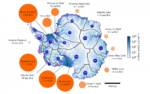
In this video, researchers investigate the millennial-scale vulnerability of the Antarctic Ice Sheet (AIS) due solely to the loss of its ice shelves. Starting at the present-day, the AIS evolves for 1000 years, exposing the floating ice shelves to an extreme thinning rate, which results in their complete collapse. The visualizations show the first 500 […]
New Ocean Current Simulations Reflect Climate Change
July 3, 2016 by
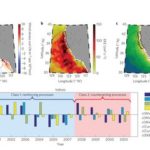
Researchers are using the Gordon supercomputer at SDSC to paint a new picture of global warming’s impact on the complex processes that drive ocean mixing in the vast eddies swirling off the California coast. “Nearly a fifth of the worldwide ocean productivity is in these zones, and no one has really looked with this level of detail at the climate change implications for these precious marine areas,” said Renault.”
Video: Climate Change, Chaos, and Inexact Computing
May 29, 2016 by

In this video from the Perimeter Institute for Theoretical Physics in Ontario, Dr. Tim Palmer from the University of Oxford presents: Climate Change, Chaos, and Inexact Computing. “How well can we predict the climate future? This question is at the heart of Tim Palmer’s research into the links between chaos theory and the science of climate change. Palmer will discuss climate modeling, the emerging concept of inexact supercomputing, and chaos theory.”