
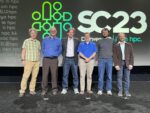
A Lawrence Livermore National Laboratory (LLNL)-led effort that performed an unprecedented global climate model simulation on the world’s first exascale supercomputer has won the first-ever Association for Computing Machinery (ACM) Gordon Bell Prize for Climate Modelling, ACM officials announced Thursday. The Simple Cloud Resolving E3SM Atmosphere Model (SCREAM) team, led by LLNL staff scientist Peter Caldwell and […]
Atos Takes Fight Over Met Office-Microsoft $1.6B Weather HPC Contract to UK High Court
May 23, 2022 by

Atos’ fight over the UK Met Office awarding a $1.56 billion contract to Microsoft to build the world’s biggest weather and climate supercomputer will soon go to the UK High Court, according to a story in the Financial Times. Atos, the leading Europe-based HPC vendor, argues that is was excluded unfairly from bids for the […]
DOE: $84M Funding Opportunity for Urban Climate Research
March 25, 2022 by
March 25, 2023 — The U.S. Department of Energy (DOE) announced a plan to provide $84 million for new observational, modeling, and simulation studies to improve the accuracy of community-scale climate research and inform equitable climate solutions to minimize adverse impacts caused by climate change. Research will focus on three tightly related scientific topics—atmospheric and environmental […]
DOE: $125M for Small Business Climate Change R&D
February 28, 2022 by
Feb. 28, 2022 — The U.S. Department of Energy (DOE) today announced $125 million for small businesses pursuing clean energy research and development (R&D) projects. The projects range from grid modernization and carbon removal to renewable energy and energy storage. More details on this funding opportunity can be found HERE. Small businesses are the backbones of […]
ORNL Researchers, Summit HPC Support IPCC Climate Change Report
August 26, 2021 by

As part of the Next-Generation Ecosystem Experiments Arctic project, scientists are gathering and incorporating new data about the Alaskan tundra into global models that predict the future of our planet. Credit: ORNL/U.S. Dept. of Energy Improved data, models and analyses from Oak Ridge National Laboratory scientists and many other researchers in the latest global climate […]
The Hyperion-insideHPC Interviews: Irene Qualters’ Long View of HPC, from a Start-up Called Cray to Today’s ‘No-Analog’ Research at Los Alamos
October 7, 2020 by

Irene Qualters, a senior-level manager at Los Alamos National Laboratory, has been at the forefront of the convergence of supercomputing and science for decades, extending back to joining Cray as one of that company’s first 100 employees. Few members of the HPC community can match her wealth of experience and wisdom regarding the future of scientific computing and its “no-analog” physics-informed AI exploration of problems confronting our planet, such as climate change.
insideHPC Special Report Optimize Your WRF Applications – Part 3
September 21, 2020 by
A popular application that simulates climate change is the Weather and Research Forecasting (WRF) model. This white paper discusses how QCT can work with leading research and commercial organizations to lower the Total Cost of Ownership by supplying highly tuned applications that are optimized to work on leading-edge infrastructure.
insideHPC Special Report Optimize Your WRF Applications – Part 2
September 17, 2020 by
A popular application that simulates climate change is the Weather and Research Forecasting (WRF) model. This white paper discusses how QCT can work with leading research and commercial organizations to lower the Total Cost of Ownership by supplying highly tuned applications that are optimized to work on leading-edge infrastructure.
insideHPC Special Report Optimize Your WRF Applications
September 8, 2020 by
A popular application that simulates climate change is the Weather and Research Forecasting (WRF) model. This white paper discusses how QCT can work with leading research and commercial organizations to lower the Total Cost of Ownership by supplying highly tuned applications that are optimized to work on leading-edge infrastructure.
insideHPC Special Report Accelerate WRF Performance – Expedite Predictions with In-Depth Workload Characterization Knowledge
September 3, 2020 by Leave a Comment
A popular application that simulates climate change is the Weather and Research Forecasting (WRF) model. This white paper discusses how QCT can work with leading research and commercial organizations to lower the Total Cost of Ownership by supplying highly tuned applications that are optimized to work on leading-edge infrastructure.