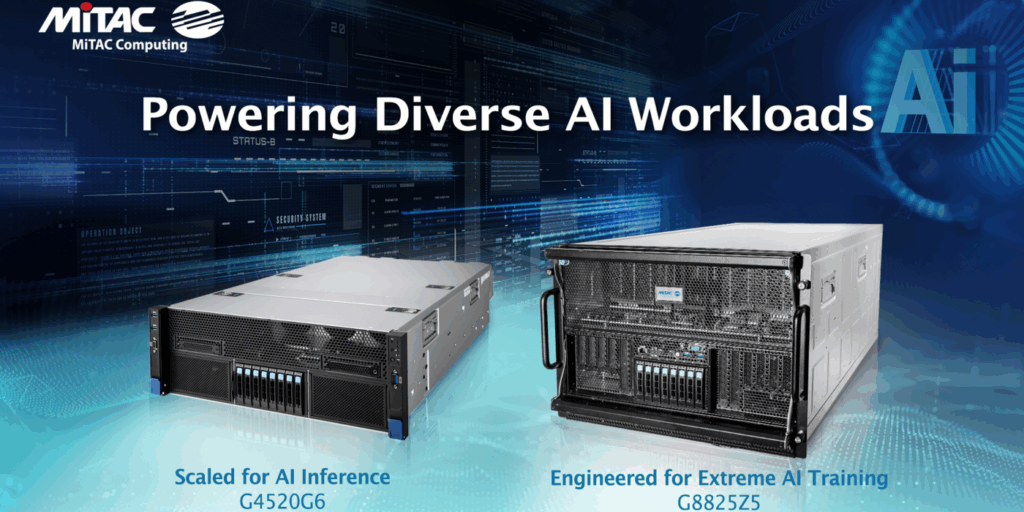

SiPearl, the company building European processors for supercomputing and AI, said it has “completed the conception” of the Rhea1 processor, which the company said has 80 Arm ….
SiPearl Tapes-out HPC and AI Chip Rhea1, Closes €130m Series A, for European Tech Sovereignty
July 9, 2025 by
Emerging Tools and Frameworks in AI: A Comparative Analysis
November 24, 2023 by

In this contributed article, graphic designer and content writer, Erika Ballo delves into some emerging tools and frameworks in AI, comparing their strengths, usability, and ideal use cases.
Making AI Accessible to Any Size Enterprise
November 19, 2020 by

In this sponsored post, our friends over at Lenovo and NetApp have teamed up with NVIDIA to discuss how the companies are helping to drive Artificial Intelligence (AI) into smaller organizations and hopefully seed that creative garden. Experience tells us that there is a relationship between organizational size and technology adoption: Larger, more resource-rich, enterprises generally adopt new technologies first, while smaller, more resource constrained organizations follow afterward, (provided that the small organization isn’t in the technology business).
Book Review: Deep Learning with TensorFlow 2 and Keras
August 4, 2020 by

If you’re a data scientist who has been wanting to break into the deep learning realm, here is a great learning resource that can guide you through this journey. It’s pretty much an all-inclusive resource that includes all the popular methodologies upon which deep learning depends: CNNs, RNNs, RL, GANs, and much more. The glue that makes it all work is represented by the two most popular frameworks for deep learning pratcitioners, TensorFlow and Keras.
Interview: Global Technology Leader PNY
July 13, 2020 by Leave a Comment

The following whitepaper download is a reprint of the recent interview with our friends over at PNY to discuss a variety of topics affecting data scientists conducting work on big data problem domains including how “Big Data” is becoming increasingly accessible with big clusters with disk-based databases, small clusters with in-memory data, single systems with in-CPU-memory data, and single systems with in-GPU-memory data. Answering our inquiries were: Bojan Tunguz, Senior System Software Engineer, NVIDIA and Carl Flygare, NVIDIA Quadro Product Marketing Manager, PNY.
Inspur Re-Elected as Member of SPEC OSSC and Chair of SPEC Machine Learning
February 21, 2020 by

The Standard Performance Evaluation Corporation (SPEC) has finalized the election of new Open System Steering Committee (OSSC) executive members, which include Inspur, Intel, AMD, IBM, Oracle and three other companies. “It is worth noting that Inspur, a re-elected OSSC member, was also re-elected as the chair of the SPEC Machine Learning (SPEC ML) working group. The development plan of ML test benchmark proposed by Inspur has been approved by members which aims to provide users with standard on evaluating machine learning computing performance.”
Book Review: Python Machine Learning – Third Edition by Sebastian Raschka, Vahid Mirjalili
February 19, 2020 by
I had been looking for a good book to recommend to my “Introduction to Data Science” classes at UCLA as a text to use once my class completes … sort of the next step after learning the basics. That’s why I was looking forward to reviewing the new 3rd edition of the widely acclaimed title “Python Machine Learning” by Sebastian Raschka, Vahid Mirjalili. The book is a comprehensive guide to machine learning and deep learning with Python. It acts as both a step-by-step tutorial, and a useful resource you’ll keep coming back to as you fill up your data science toolbox.
Efficient Model Selection for Deep Neural Networks on Massively Parallel Processing Databases
February 4, 2020 by

Frank McQuillan from Pivotal gave this talk at FOSDEM 2020. “In this session we will present an efficient way to train many deep learning model configurations at the same time with Greenplum, a free and open source massively parallel database based on PostgreSQL. The implementation involves distributing data to the workers that have GPUs available and hopping model state between those workers, without sacrificing reproducibility or accuracy.”
Podcast: Advancing Deep Learning with Custom-Built Accelerators
January 3, 2020 by

In this Chip Chat podcast, Carey Kloss from Intel outlines the architecture and potential of the Intel Nervana NNP-T. He gets into major issues like memory and how the architecture was designed to avoid problems like becoming memory-locked, how the accelerator supports existing software frameworks like PaddlePaddle and TensorFlow, and what the NNP-T means for customers who want to keep on eye on power usage and lower TCO.
insideAI News Guide to Optimized Storage for AI and Deep Learning Workloads
September 10, 2019 by Leave a Comment
This new technology guide from DDN shows how optimized storage has a unique opportunity to become much more than a siloed repository for the deluge of data constantly generated in today’s hyper-connected world, but rather a platform that shares and delivers data to create competitive business value. The intended audience for this important new technology guide includes enterprise thought leaders (CIOs, director level IT, etc.), along with data scientists and data engineers who are a seeking guidance in terms of infrastructure for AI and DL in terms of specialized hardware. The emphasis of the guide is “real world” applications, workloads, and present day challenges.