httpv://www.youtube.com/watch?v=4Et8ywwt5Ec
In this video from SC12, Professor Kei Hiraki from the University of Tokyo discusses the historical development of accelerator technology that has culminated in the new Intel Xeon Phi coprocessor.


httpv://www.youtube.com/watch?v=4Et8ywwt5Ec
In this video from SC12, Professor Kei Hiraki from the University of Tokyo discusses the historical development of accelerator technology that has culminated in the new Intel Xeon Phi coprocessor.

Many industries are starting to run HPC in the cloud. Find out how GPU-accelerated compute, from AWS and NVIDIA, is helping organizations run HPC workloads and AI/ML jobs faster, in a more energy-efficient way.
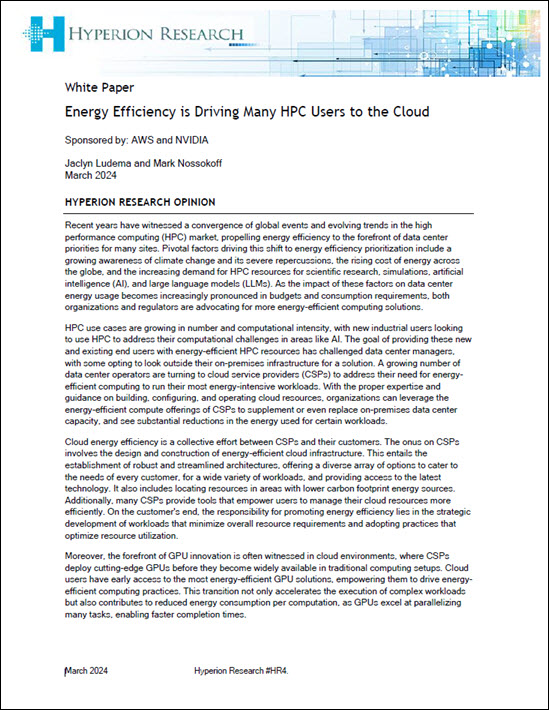
The high-performance computing (HPC) market is witnessing a notable shift towards the cloud, partially driven by the benefits of enhanced energy efficiency. According to Hyperion Research nearly every organization running HPC workloads is either already using or investigating the cloud to accelerate application performance, with the cloud market for HPC workloads forecast to reach $11.5 […]

 Featured RSS Feed More News from insideBIGDATA